

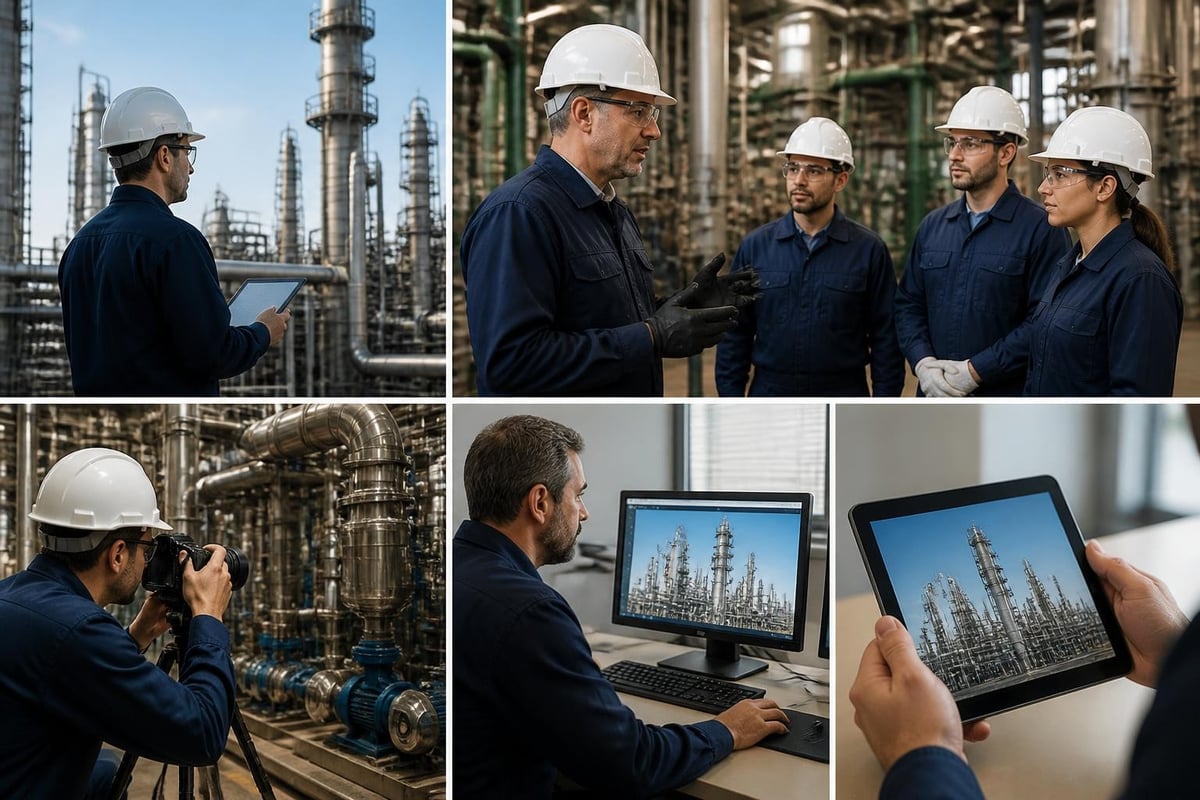
Chemical industrial photography represents a specialised intersection of technical expertise, safety awareness, and visual storytelling within some of the most challenging environments a commercial photographer can encounter. From pharmaceutical manufacturing facilities to petrochemical refineries, the work demands not only photographic skill but also an understanding of hazardous environments, compliance requirements, and the unique documentation needs of chemical industries. For organisations operating in this sector, professional imagery serves multiple critical functions: compliance documentation, safety training materials, marketing collateral, annual reporting, and technical record-keeping that must withstand regulatory scrutiny.
Understanding Chemical Industrial Photography
Chemical industrial photography encompasses the documentation of manufacturing processes, equipment, facilities, and personnel within chemical production and research environments. This specialised field extends beyond traditional industrial photography due to the inherent hazards present in chemical facilities and the rigorous documentation standards required by regulatory bodies.
The scope of this work varies considerably. At one end, a photographer might capture wide-angle facility shots for an annual report or marketing campaign. At the other, they may document specific laboratory procedures for standard operating procedure (SOP) manuals or capture forensic-quality images of equipment failure for incident investigation. Each application requires different technical approaches, safety protocols, and post-production workflows.
Applications Across the Chemical Industry
Manufacturing documentation represents a primary application, where chemical industrial photography records production lines, storage systems, and quality control processes. These images support operational reviews, equipment audits, and serve as baseline records for continuous improvement initiatives. Pharmaceutical companies, for instance, require photographic documentation that demonstrates compliance with Good Manufacturing Practice (GMP) standards.
Research and development facilities need imagery that captures laboratory setups, experimental apparatus, and analytical instrumentation. Such documentation supports patent applications, research publications, and knowledge transfer between teams. The University of Washington photography guidelines provide comprehensive protocols for photographing research spaces safely, addressing everything from personal protective equipment to hazardous material identification.
Safety and training materials rely heavily on professional imagery. Chemical facilities use photographs to illustrate proper PPE usage, emergency response procedures, and hazard identification. Clear, well-composed images communicate safety protocols more effectively than text alone, particularly in multilingual workforces.
Safety Protocols and Site Preparation
Safety considerations distinguish chemical industrial photography from most other commercial photography disciplines. Before any camera equipment enters a chemical facility, photographers must complete site-specific safety training, understand the chemical hazards present, and know emergency procedures.
Personal protective equipment requirements vary by location and activity. Basic PPE typically includes safety glasses, steel-toed boots, and high-visibility clothing. Chemical environments may require respirators, chemical-resistant gloves, flame-resistant clothing, or full-face shields. The photographer must understand which PPE is mandatory and how to work effectively while wearing it. Camera equipment itself may require intrinsically safe housings in explosive atmospheres or decontamination procedures before leaving certain zones.
Pre-Shoot Risk Assessment
A thorough risk assessment examines every aspect of the planned shoot. This includes identifying chemicals present in the area, understanding their hazards, reviewing material safety data sheets (MSDS), and determining appropriate controls. The assessment should also consider physical hazards such as elevated work platforms, confined spaces, moving machinery, and high-temperature equipment.
Communication with site personnel is essential. The photographer must coordinate with production managers, safety officers, and operations staff to schedule shoots during appropriate times, understand process constraints, and ensure all parties know what will be photographed and why. For facilities producing materials used across manufacturing sectors-from companies like OTR TIRE THAI that require chemical compounds in tire manufacturing to construction material suppliers-the timing of photography around production schedules becomes crucial.
Documentation of the risk assessment and safety briefing protects both photographer and client. Many facilities require written permits-to-work, hot work permits, or confined space entry permits before photography can commence. These administrative requirements should never be viewed as obstacles but as essential safeguards.
Technical Considerations and Equipment Selection
Chemical industrial photography presents unique technical challenges that influence equipment selection and shooting techniques. Lighting conditions in industrial facilities are often poor, with sodium vapour or fluorescent fixtures creating colour casts and uneven illumination. Dust, vapour, and temperature extremes can damage equipment. Restricted spaces limit where photographers can position themselves and their gear.
Camera equipment must be robust and adaptable. Full-frame sensors perform better in low light and offer superior dynamic range for capturing high-contrast industrial scenes. Wide-angle lenses (16-35mm) are essential for tight spaces and large equipment, whilst telephoto lenses (70-200mm) allow safe documentation of hazardous processes from a distance. Macro lenses serve specialised purposes when capturing small-scale chemical processes or sample documentation.
Lighting Chemical Environments
Artificial lighting becomes necessary when ambient light is insufficient or creates unflattering shadows. Battery-powered LED panels offer continuous light that's easily controllable and safe in most chemical environments. Flash units provide more power but must be approved for use in potentially explosive atmospheres-only ATEX-certified or intrinsically safe flash units are permissible in Zone 1 or Zone 2 hazardous areas.
Light positioning in chemical facilities requires creativity within safety constraints. Boom stands and magic arms help position lights in challenging spaces, but all equipment must be secured to prevent trip hazards or interference with operations. Diffusion and reflection techniques soften harsh industrial lighting whilst maintaining the authentic character of the environment.
| Challenge | Technical Solution | Safety Consideration |
|---|---|---|
| Low ambient light | High-ISO sensors, LED panels, tripods | Ensure all stands stable and secured |
| Colour cast from facility lighting | Custom white balance, RAW capture | None specific |
| Restricted access angles | Wide-angle lenses, remote triggers | Maintain safe distance from hazards |
| Explosive atmospheres | ATEX-certified equipment only | Formal hazardous area classification required |
| Chemical vapours | Weather-sealed bodies, protective housings | Regular equipment inspection post-shoot |
| Moving machinery | Fast shutter speeds, strobes | Never compromise safety for the shot |
Documentation Standards and Compliance Requirements
Chemical industrial photography often serves regulatory and legal purposes, requiring adherence to specific documentation standards. The SWGDE Guidelines for Evidence Photography in a Controlled Setting outline best practices for forensic-quality documentation that maintains image fidelity, proper scaling, and chain of custody-principles that apply equally to incident investigation and compliance documentation in chemical facilities.
Metadata becomes particularly important in industrial documentation. Each image should be tagged with location, date, time, equipment settings, and relevant identifying information such as equipment tag numbers or batch identifiers. This metadata proves invaluable when images are referenced months or years later during audits, investigations, or regulatory reviews.
Image Organisation and Archival
Systematic organisation of chemical industrial photography ensures images remain accessible and useful. A logical folder structure might separate images by facility area, equipment type, or project phase. Consistent naming conventions that include date, location, and subject facilitate rapid retrieval.
Long-term archival considerations matter in industries with extended equipment lifecycles and regulatory retention requirements. RAW files should be retained alongside processed JPEGs to allow future reprocessing as technology advances. Redundant backup systems-ideally following the 3-2-1 rule (three copies, two different media types, one off-site)-protect against data loss. Cloud-based solutions offer geographic redundancy but must comply with client confidentiality and data sovereignty requirements.
Capturing Process and Equipment Detail
The heart of chemical industrial photography lies in effectively documenting processes, equipment, and systems. This requires both technical proficiency and an understanding of what matters to the client and their stakeholders. A pharmaceutical client may need images that demonstrate clean-room protocols and contamination controls. A petrochemical facility might require documentation of corrosion, equipment wear, or maintenance procedures.
Wide-angle establishment shots provide context, showing how individual pieces of equipment relate to the broader system. These overview images are essential for orientation and understanding process flow. From there, the photographer moves progressively closer, documenting equipment groups, individual units, control panels, and finally detail shots of specific components, gauges, or sample points.
Workflow and Process Documentation
Photographing chemical processes in sequence creates valuable documentation for training, troubleshooting, and continuous improvement. A systematic approach captures each step of a procedure, from raw material handling through reaction, separation, purification, and final product packaging. Recent research on computer vision for chemical process monitoring highlights how camera-based methods increasingly support analytical applications, but human-captured professional photography remains essential for communication and documentation purposes.
Detail photography reveals equipment condition, instrumentation accuracy, and compliance with specifications. Close-up images of valve positions, pressure gauges, temperature displays, and sample points provide objective records. When documenting equipment for maintenance or incident investigation, systematic coverage from multiple angles ensures nothing is overlooked. This same meticulous approach proves valuable across various industrial contexts, much as construction and industrial photography requires capturing both scale and detail to tell a complete story.
People and Safety Culture Photography
Chemical industrial photography extends beyond equipment and processes to capture the people who operate facilities safely and efficiently. These images humanise organisations, support recruitment, demonstrate safety culture, and provide powerful content for annual reports and marketing materials. However, photographing personnel in chemical facilities introduces additional considerations beyond standard workplace photography.
Consent and privacy matter. Workers must understand how their images will be used and provide written consent, particularly for marketing or public-facing materials. Some individuals may prefer not to be photographed for personal or security reasons, and these preferences must be respected. In unionised facilities, collective agreements may specify requirements for photography involving workers.
Demonstrating Safety Culture Through Imagery
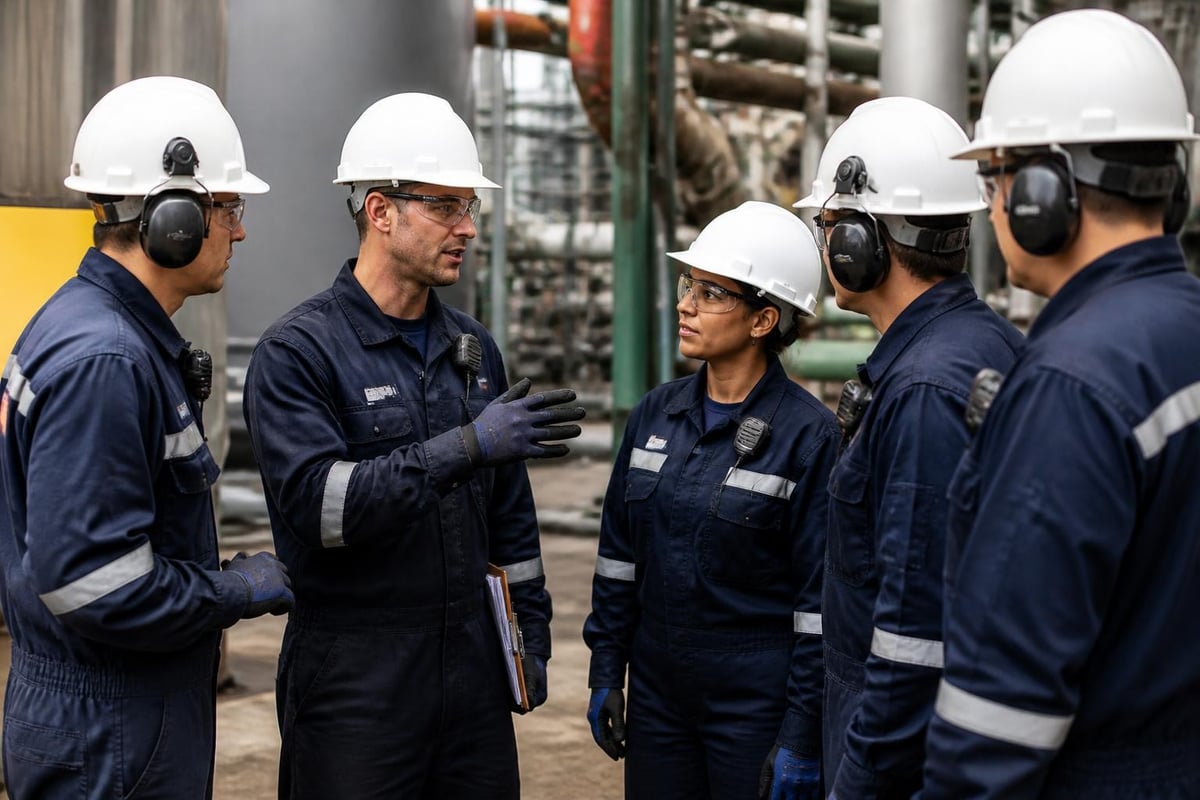
Authentic safety culture photography shows workers properly equipped and following procedures, not staged scenarios with actors. The challenge lies in capturing natural, engaging images whilst ensuring every aspect of PPE and procedure shown is absolutely correct. A single image showing improper glove use or missing eye protection undermines an organisation's safety message and creates liability.
Working quickly and unobtrusively minimises production disruption. Chemical processes often cannot be stopped for photography, requiring the photographer to work around ongoing operations. This demands situational awareness, efficiency, and respect for production priorities. The ability to capture natural moments without extensive direction separates skilled workplace photographers from those merely competent with camera equipment.
| Subject Type | Key Considerations | Deliverable Purpose |
|---|---|---|
| PPE compliance | All equipment correctly worn and visible | Safety training, compliance documentation |
| Operating procedures | Accurate sequence, correct technique | Standard operating procedures, training |
| Team coordination | Natural interaction, appropriate context | Annual reports, recruitment, internal communications |
| Supervision and oversight | Clear hierarchy, safety leadership | Compliance documentation, organisational culture |
| Emergency response | Staged exercises with proper protocols | Emergency training, drill documentation |
Post-Production and Delivery Considerations
Post-production workflows for chemical industrial photography balance technical quality with authenticity and compliance requirements. Unlike commercial photography where extensive retouching is standard, documentation imagery must accurately represent conditions as they existed. Adjustments to exposure, contrast, and colour balance are acceptable and often necessary, but manipulation that alters the factual content of an image may compromise its value as evidence or documentation.
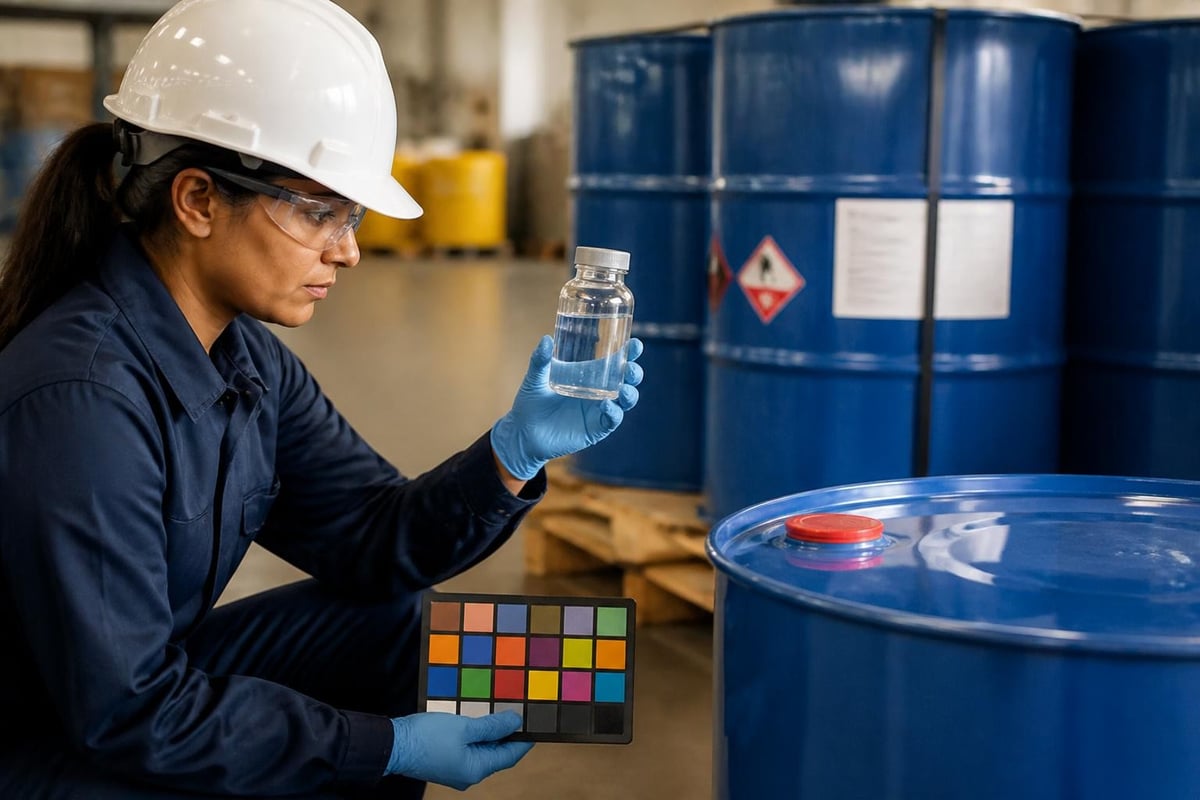
Colour accuracy matters particularly when photographing chemical products, control panels, or hazard labels. Custom colour profiles created under facility lighting conditions improve colour fidelity. Alternatively, including colour reference cards in wide shots enables accurate colour grading during post-production.
Secure Delivery and Client Confidentiality
Chemical facilities often contain proprietary processes, sensitive information, or security concerns. Photographers must implement secure workflows that protect client confidentiality. This includes encrypted file transfer, secure storage, confidentiality agreements, and sometimes security clearances for accessing certain facilities. Images showing process details, instrumentation, or facility layouts may be classified as confidential commercial information.
Delivery formats should match client needs. High-resolution images suit printing and detailed documentation, whilst web-optimised versions serve digital applications. Some clients require specific file naming conventions, metadata standards, or delivery platforms to integrate images into their document management systems. Understanding and accommodating these requirements demonstrates professionalism and facilitates long-term client relationships.
Specialised Applications and Emerging Techniques
Chemical industrial photography continues to evolve with technology and changing industry needs. Specialised applications push the boundaries of traditional documentation approaches, offering new insights and capabilities.
Forensic documentation in chemical facilities applies rigorous standards from evidence photography to incident investigation and equipment failure analysis. The International Association for Identification provides comprehensive resources on forensic imaging protocols that maintain evidentiary value. Scale references, lighting consistency, and complete documentation from multiple angles ensure images can withstand technical and legal scrutiny.
Advanced Imaging Techniques
Thermal imaging reveals temperature distributions across equipment, identifying hot spots that indicate inefficiency or impending failure. Chemical facilities increasingly use thermal cameras for predictive maintenance, but the specialist knowledge required to interpret thermal images means this remains a specialised subset of chemical industrial photography.
Ultraviolet and infrared photography finds applications in forensic chemistry and contamination detection. The UK Government’s guidance on fingermark visualisation in forensic laboratories details imaging techniques that, whilst specific to forensic science, demonstrate principles applicable to chemical detection and contamination imaging.
High-speed photography captures rapid chemical reactions, mixing processes, or safety valve discharge events that occur too quickly for standard video or still photography. Specialist high-speed cameras recording thousands of frames per second reveal detail invisible to the naked eye, supporting research, troubleshooting, and safety analysis.
Integration with Broader Industrial Documentation
Chemical industrial photography rarely exists in isolation but forms part of comprehensive documentation strategies alongside engineering drawings, process flow diagrams, and technical reports. Understanding how photography integrates with other documentation types enhances its value and utility.
Asset management systems increasingly incorporate photographic documentation of equipment, showing condition at installation, during periodic inspections, and throughout the asset lifecycle. Time-stamped images create visual maintenance histories that supplement written records. This systematic approach proves valuable across various industries-similar to how detailed site documentation benefits projects from Pink Palm Pavers hardscaping installations to complex chemical facility modifications.
Supporting Technical Communication
Technical documentation such as standard operating procedures, maintenance manuals, and training materials relies heavily on clear, accurate photography. Images must precisely illustrate the subject without distracting elements or ambiguity. Consistent lighting, backgrounds, and angles across a series of procedural images aid comprehension and create professional, polished documentation.
Marketing and corporate communications represent a different application, where chemical industrial photography must balance technical accuracy with visual appeal. These images communicate capability, scale, and sophistication to potential clients, investors, and other stakeholders. Whilst maintaining authenticity, the photographer can employ composition, lighting, and timing to create compelling imagery that elevates perception of the organisation.
Building Expertise in Chemical Industrial Photography
Developing proficiency in chemical industrial photography requires ongoing investment in knowledge and skills beyond standard commercial photography training. Safety certification forms the foundation-completion of recognised industrial safety courses demonstrates commitment to safe practice and builds credibility with clients.
Technical knowledge of chemical processes, equipment, and industry terminology enables more effective communication with clients and more insightful photography. Understanding the difference between a reactor and a distillation column, recognising common instrumentation, and knowing basic process flow concepts allows photographers to anticipate shots, ask relevant questions, and deliver images that meet unstated needs.
Professional Development and Industry Engagement
Membership in professional photography organisations provides access to resources, networking, and continuing education. Industry-specific associations such as chemical engineering societies offer opportunities to understand client perspectives and emerging industry trends. Publishing work, presenting at conferences, or contributing to industry publications builds reputation and demonstrates expertise.
Portfolio development in this specialised field requires patience and strategic client relationships. Chemical facilities understandably restrict photography, and much work remains confidential. Building a portfolio often means starting with less sensitive applications-perhaps exterior architecture, office environments, or carefully approved marketing images-before gaining access to more restricted areas as trust develops.
Chemical industrial photography demands the convergence of technical photographic skill, safety awareness, compliance knowledge, and industrial understanding. For organisations across the chemical sector, professional documentation creates value through compliance support, technical communication, marketing impact, and operational insights. Matt Vas Photography brings over 25 years of commercial photography experience to challenging industrial environments, combining genuine interest in the work being documented with the technical expertise to deliver credible, professional imagery that serves both immediate and long-term organisational needs.